Sunday, February 14, 2010

Mao Asada’s journey and my evolution as a Mao fan: Part 12

Part 12: 2007-08 season—Crisis

In truth, the smooth sailing at Four Continents belied undercurrents of uncertainty.  Anyone watching the competition would have noticed that Mao Asada’s coach, Rafael Artunian, was not there.  Soon after that, they ended their coaching relationship permanently.

In Mao Asada, Miracle Seventeen, Mao’s mother tells their side of the story.  According to her, the original plan was for Mao to stay in Japan to practice after Nationals.  Rafael was supposed to join her in Japan, and together they would travel from Japan to Korea.  They had made a promise.  However, Rafael never came to Japan.  And he refused to go to Four Continents, saying, “I haven’t seen her practice for a while, so I cannot take responsibility.”

About the incident, Mao said, “I didn’t receive any contact from him.  So when I heard [he wasn’t coming], I was shocked.  I thought, ‘Why won’t he come here for me?’  I felt that very strongly.  Because I had been waiting for Rafael to come.
“Around New Year’s, my hip hurt a little bit and my practices weren’t going well.  And then, I felt kind of worried about Four Continents or something; I can’t really say.
“The reason I went to America was because I couldn’t practice satisfactorily in Japan.  I was glad that I was able to practice a lot abroad, and my lifestyle was unique.  I thought it was a fulfilling two years.” (1)

But in May 2007, they had opened a new rink exclusively for figure skaters at Chuukyou University, near Mao’s hometown, thus eliminating her need to go abroad to get private ice time.   And now that her and her mother’s trust in Rafael had been shattered, they decided to end the coaching relationship.


But that left Mao with no coach and just over one month until Worlds.  Mao, never one to complain, said that not having a coach didn’t bother her.  She didn’t want to use the absence of a coach as an excuse.  But the unusual situation was certainly taking a mental toll on Mao, and the JSF scrambled to find a new coach for Mao.  They sent a frantic offer letter to Tatiana Tarasova, and amazingly, she agreed to accept.  She said, “I choreographed her program this season, and I also watched her practice over the summer.  If Mao says she absolutely wants me, then I will accept.  In return, I want her to come to Russia two weeks before the World Championships.  If that doesn’t happen, then I won’t be able to train her.” (2)

For a moment, it seemed like Mao’s problems had been solved.

But the day after she returned home from Korea, the real crisis arrived.  Mao was practicing her triple-flip/triple-loop combination, when she made an awkward movement with her left foot and heard a popping sound.

An MRI revealed that she had sprained her ankle.

***

For awhile, Mao was in shock.  It didn’t hurt much, but she couldn’t skate at all.  "What if it doesn’t heal in time for Worlds?!", she worried. 

For one week, all she could do was train in the gym.  In the second week, she was able to move on the ice with her ankle heavily taped.  In the third week, she tried some single jumps.  But she found that she had a hard time feeling the ice with her ankle taped.  On the other hand, if she removed the taping, her ankle wasn’t stable.

All during this time, Mao Asada trained by herself, with only a few JSF members supervising her.  She couldn’t go to Russia in this condition, so the coaching agreement with Tarasova was canceled.

Finally, in the week before Worlds, Mao was able to do triple jumps again.  Her ankle had healed just in time.  And Mao found that surprisingly, she was no longer nervous.  After having to deal with the injury, after feeling despair that she might not be able to compete, she was elated to find that she could skate again and felt a strong desire to go out and win Worlds.

She trained in Japan until the very last minute, and arrived in Göteborg, Sweden just two days before the start of the competition.  She was simply glad that she had made it.

When she arrived, the media asked her about her skating condition.  It wasn’t quite the truth, but she said that “it's the same as usual; it's good.” (3)


Press conference for 2008 Worlds

Just like with her broken finger before 2006 Nationals, Mao never said a word about her injury.  No one outside of the JSF had any idea that she had been unable to practice fully for three weeks.

But Mao Asada doesn’t like to lie and she doesn’t make excuses.  So she resolved to make her statement—“My condition is good”—into the truth.

Endnotes
1) See pgs 91-92 in 浅田真央、17歳 [Mao Asada, Miracle Seventeen].
2) Ibid, pg 94.
3) Ibid, pg 104-105.

Thursday, February 11, 2010

Mao Asada’s journey and my evolution as a Mao fan: Part 11

Part 11: 2007-08 season—Sunshine after the storm

After the 2007 Grand Prix Final, I may have had thoughts of doubt and despair, but Mao Asada had more important things to worry about—Aero’s new puppies!  Yes, during the Grand Prix Final, Mao’s beloved toy poodle, Aero, gave birth to three puppies.  (See pictures in Message from Mao No. 29 on this page.)  Mao and Mai kept two of them, and later named them Tiara (ティアラ) and Komachi (小町). 

When Mao returned to Japan for the 2007 Japan National Championships, she not only got to see Aero’s new puppies, but a lot of people in the skating world like Midori Ito that she hadn’t seen in months.

At Nationals, Mao finally overcame her mental block and skated her short program beautifully at the 2008 Japan National Championships.

2008 Japan National Championships SP
“Fantasy for Violin and Orchestra” by Nigel Hess

(Please click on the YouTube link to watch in HD! I recommend it!)

The costume she wore—she actually borrowed it from Mai—remains my very favorite.


Although she popped the triple axel in the long program, she did enough to win her second straight National title.

Mao Asada with Japan National Championships trophy


(Looks heavy!)


I think the success in the short program marked a turning point in Mao’s season.  She had been so excited about her new short program—her chance to reveal a new side of Mao—and she had shed bitter tears when she couldn’t execute it perfectly.  But now, she had finally succeeded.  She had gained so much confidence in her program that she even performed it as her exhibition piece in the gala after Nationals, the annual “Medalists on Ice.”

2008 Medalists on Ice (with live orchestra)
“Fantasy for Violin and Orchestra” by Nigel Hess


(Click on the YouTube link to watch in HD!)


***

Mao’s next stop was the Four Continents Championship in Goyang, Korea.  Surprisingly, Yu-Na Kim would not be there.  Yes, just like in the previous season, Yu-Na Kim suffered an injury right around the beginning of the year, and she would not be able to compete in her home country.

Given that Mao was entering “enemy territory,” she was surprised to receive such a warm welcome.  At this point in time, the Mao/Yu-Na rivalry was not so tense, and the Korean skating fans greeted Mao with their boisterous cheers. 

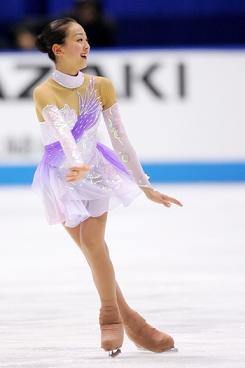
The new year also brought Mao new costumes: a long-sleeved silver costume with a lavender skirt and a V-neck cut for her short program, and a gorgeous rose pink dress for her long program. 

Mao’s new SP costume

In the short program, Mao stepped out of her triple lutz, and her triple loop in her combo was downgraded, but she held onto first place. 

Mao in the kiss ‘n’ cry after the SP

In the long program, Mao nailed her opening triple axel, racking up GOEs of +1.86 points; making that single jump worth 9.36 points, or nearly the same as the base value of a triple-flip/triple toe loop combo (9.5 points).  She skated the rest of her program cleanly, and though she received an underrotation call on the triple toe loop in her triple-flip/triple-toe loop combo and an edge call on her lutz, she managed to score 132.31, very close to her personal best.


Mao's new FS costume


2008 Four Continents Championship FS

"Fantasie-Impromptu" by Frederic Chopin


Mao finished the competition with nearly a 14-point lead over the second place finisher, Joannie Rochette of Canada.


2008 Four Continents Championship podium: Joannie Rochette (silver), Mao Asada (gold), Miki Ando (bronze)

But her time in Korea was not over yet.  At the exhibition gala, Mao delivered a stirring performance of her exhibition number, “So Deep is the Night,” based on Frederic Chopin’s Etude Op. 10 No. 3 in E major, “Tristesse.”

2008 Four Continents Championship Exhibition

“So Deep is the Night,” based on Chopin’s “Tristesse”

(Click on the YouTube link to watch in HD!)

This number remains one of my favorite.  Effortlessly elegant, heartbreakingly beautiful, simply sublime.  I could not help but feel moved.

Mao was also interviewed for Korean TV, charming the reporter with her bright smile and even giving Korean fans a chance to hear her sing.


Mao Asada on Korean TV


And of course, there was tons of yummy Korean food to be eaten

With her short program problems seemingly behind her and the triple axel in great shape, Mao looked ready to conquer the world.  No one would have guessed that crisis was about to befall her…

Wednesday, February 10, 2010

Mao Asada’s journey and my evolution as a Mao fan: Part 10

Part 10: 2007-08 season—Some disillusionment and despair (from me)

In December 2007, Mao Asada headed to Torino, home of the 2006 Olympics, for her third straight Grand Prix Final.  And it started off disastrously.  The triple-triple combo that had been a stumbling block for her—she nearly fell on it.  Then, during the approach for her triple lutz, she slid and lost her timing, so she omitted the jump altogether.  Only two jump passes completed and one with a near-fall.  It was no surprise that she found herself in last place (6th) after the short program.

2007 Grand Prix Final SP (age 17) (ESPN commentary)
“Fantasy for Violin and Orchestra” by Nigel Hess

(For a higher-quality widescreen version, please click here.)

Mao ended up a little more than 5.5 points behind the leader, Yu-Na Kim, and just under 3 points behind 2nd place, Caroline Zhang of the US. 

Well, you can guess what happened the next day.  No stranger to "coming from behind," Mao Asada pulled out all the stops and skated her heart out in the free program the next day.

2007 Grand Prix Final FS
(ESPN commentary)
“Fantasie-Impromptu” by Frederic Chopin

(For a higher-quality widescreen version, see here.)

Not only did she land the triple axel, but she also successfully landed two triple-triple combinations: the triple-flip/triple-loop, her usual combo, and the triple-flip/triple-toe loop combo.  And the way that she ends the program with a double axel before the final note--who else can do that?!  


Mao received 132.55 points for her free skate, very near her record score from the 2007 World Championships.  And just like at 2007 Worlds, she burst into tears at the end—tears of relief, tears of satisfaction, tears that said, “I did it!”  

Once again, Mao "met the moment," as Tracy Wilson said.  Wow.  And the tears--that was just part of why I love Mao: because she wears her heart on her sleeve.  You can't help but go through the emotional highs and lows with her.  And oh, how it warmed my heart to see Rafael Artunian hugging and carrying the crying/smiling Mao off the rink!

I was not the only one who was excited.  Tatiana Tarasova was there watching as a commentator for Russian TV, and she exclaimed, “She has given her all!.. has given her all... Has proved to herself that she can!..”  (Read the full translation of her commentary here.  Thanks to summervie from the Mao Asada fan forum!)


Rafael Artunian, Tatiana Tarasova, and Mao Asada at 2007 GPF

As the rest of the field posted scores well below Mao’s, I began to think, Mao might actually have a chance to win this!  How amazing would that be?  To go from last to first?

The leader after the short program, Yu-Na Kim, was the final skater to take the ice.  She fell on her second jump, a triple loop, but skated the rest of her program cleanly.  Her score?  132.21, a mere 0.34 points behind a completely clean Mao Asada.  She easily clinched her second straight Grand Prix Final gold.


2007 Grand Prix Final podium: Mao Asada (silver), Yu-Na Kim (gold), Carolina Kostner (bronze)

I was stunned.  “How can that be?”, I thought.  So I looked at the protocols.  Although Mao Asada had gotten full credit for all her jumps (nothing was marked underrotated), she lost quite a few points through negative GOEs on her jumping passes, especially on the edge-called triple lutz.  In contrast, Yu-Na Kim received positive GOEs across all of her elements (except the triple loop that she fell on).  In addition, Yu-Na received higher PCS than Mao.

And then, I thought, “If that’s how they’re going to judge it—if Mao Asada can skate her heart out and land all her jumps, while Yu-Na Kim falls, and their scores end up practically the same—if that's how it's going to be, then I don’t think I want to watch skating anymore.”

***

Even I, the ardent Mao fan, had to admit that Yu-Na Kim was a very good skater.  Even I could concede that Yu-Na Kim had a polish to her programs that Mao Asada was lacking.  Every element was done cleanly; she didn’t make edge errors nor underrotate.  She sold every jump, every spin, every spiral, maintaining the performance aspect throughout her whole program.  And although her facial expressions seemed very affected, very artificial, to me, at least she made an effort.  Mao, on the other hand, seemed like she sometimes forgot about performing.  Sometimes it seemed like she was only concentrating on the jump she had to do next.  Moreover, there was the issue of mental toughness—Yu-Na Kim seemed to handle the pressure very well, whereas Mao couldn’t get her head together for the short program.

But that didn’t mean that I liked Yu-Na Kim.  No, not at all.  I could objectively see that she was good, but I did not think she was better than Mao.  On a more subjective level, I simply did not enjoy watching Yu-Na’s skating.  This might be in part due to my pro-Mao bias, but recently I think it has something to do with my ballet background as well.  Every spiral of Yu-Na's that lacked flexibility, every less-than-graceful line made me wish I were watching Mao.  I felt the same way about many of the other less flexible and less graceful ladies, but I did not care as much because they were not even close to rivaling Mao.

***

So at this point in this time, I felt disillusioned.  I looked at the scores and thought, “gee, maybe Mao Asada can’t do it.  She can't seem to get her head together for the short program, and the judges seem to like Yu-Na. She’s probably going to win Worlds at this rate.” 

And this is when my interest in skating waned.  Because
I remembered how painful it was to watch Mao Asada come so close to gold at the 2007 Worlds and end up with silver, and I did not want to see that again.  

Because like Tarasova, I believed that Mao was the "real star," the "marvelous girl" who "would achieve everything."


2007 Grand Prix Final banquet
Daisuke Takahashi, Mao Asada, Yukari Nakano

Mao Asada’s journey and my evolution as a Mao fan: Part 9

Part 9: 2007-08 season—Signs of vulnerability

Mao Asada’s 2007-08 competitive season had a fiery start—literally.  In late October, Mao awoke to find the power out.  Soon after they were told to evacuate Lake Arrowhead immediately to escape the wildfires ravaging Northern California.  She and Rafael ended up training in Toronto for a few days before heading to Quebec City for the 2007 Skate Canada.   Of course, Mao never complained, never said that the situation upset her.

But at the competition, she was not able to show the world a new improved Mao in her challenging, maturing short program.  She almost fell on the triple loop in her opening triple-flip/triple-loop combination jump and found herself in third place after the short.

The next day she rallied and skated a clean long program capped off with a bright smile.

2007 Skate Canada FS (age 17)
“Fantasie-Impromptu” by Frederic Chopin


She landed the triple-flip/triple-loop combo that had given her trouble in the short (though it was judged underrotated), but she did not attempt her signature triple axel.  It was the first time she had purposely omitted the triple axel since becoming a senior.  Still, it did not prevent her from scoring her first victory of the season.


***

At this point in time, I was still a casual fan.  I knew that Mao had worked with Tarasova over the summer, but I didn’t really know who she was.  I also had no idea about the wildfire incident.  I thought Mao’s performance in the short program was a bit disappointing, but it was just the first competition of the season, after all.  I thought it was a little more intriguing that Mao left out the triple axel.

Here, for the first time, I was introduced to the concept of “edge calls.”  Starting with the 2007-08 season, the technical specialist began checking to see if the lutz and flip were launched from the correct edge: the lutz from the outside edge and the flip from the inside edge.  If the lutz takeoff was from an inside edge, an error known as a “flutz,” the tech specialist would mark it with an “e,” and the judges were required to give negative GOE’s. 

All of a sudden, Mao, a notorious flutzer, started getting receiving substantially negative GOE’s for a jump that used to garner her positive GOE’s.  She was not the only one; Miki Ando also lost points for launching her flip from an outside edge (an error known as a “lip”).  At this point, however, I don’t think I fully understood the judging system nor did I realize the full magnitude of the deduction.

***

At Mao’s second Grand Prix event of the season, the Trophee Eric Bompard, her “curse of the short program” struck again, and she popped the triple loop in her triple-flip/triple-loop combination.  It was the same mistake she had made at the 2007 World Championships.  She ended up first after the short program, but she cried for 30 minutes after the program. 

The American ESPN commentators couldn’t understand why she was crying—after all, she was in first place—but I knew.  It was because once again, Mao messed up the combo that she could do perfectly in practice.  Because for Mao, it’s not just about winning or being in first place; it’s about doing everything that she is capable of. 

The next day, Mao easily won the long program and the competition despite falling on her opening triple axel and receiving a time violation deduction. 

2007 Trophee Eric Bompard FS (age 17)
“Fantasie-Impromptu” by Frederic Chopin


It was not her best skate by any means, but one aspect of her performance showed me she had matured as a skater: even though she fell on the triple axel, she picked herself up and skated the rest of her program cleanly.  In the previous season, if Mao messed up the triple axel, she would let it affect the rest of her program; she would kind of give up.  That had happened at the 2006 Skate America and the 2006 Grand Prix Final.  But here she kept fighting; she didn’t let the fall faze her.  She was no longer letting the triple axel dictate the rest of her program, which I thought was an important development.


2007 Trophee Eric Bompard podium: Kimmie Meissner (silver), Mao Asada (gold), Ashley Wagner (bronze)

On paper, the 2007 Grand Prix season was her best yet—she won both competitions she entered—but this fact obscures the rather shaky performances she delivered, especially in the short program.  She may have won two GP gold medals, but she also showed some signs of vulnerability.

Addenda
1)  Mao actually gave the first performance of her short program at the 2007 International Counter Match held in Japan.  Watch it here:

It’s interesting to watch her program in its original form; some aspects of the choreography were modified by the time she performed it at Worlds in 2008.

Tuesday, February 9, 2010

Mao Asada’s journey and my evolution as a Mao fan: Part 8

Part 8: 2007 Off-season—Sharing her smile with the globe

Mao Asada was quite the jet-setter in summer 2007.

She skated in “Stars on Ice” in Canada, performing her lovely “Nocturne” SP program and giving the fans a glimpse of a skater who would probably return three years later to battle for Olympic gold.  Why "Nocturne" instead of her "Carmen" exhibition?  Because she wanted to erase the mistake on her triple-triple combo at 2007 Worlds, and put on one last clean performance.

Stars on Ice (in Vancouver) - April 2007


(click on the YouTube link to watch in HD)

While there, she and Mai took a sightseeing tour of Vancouver with Japanese TV personality and devoted skating fan Shuuzou Matsuoka.  Not only did they get to see the sights, sample the local cuisine, and shop, but Mao also got her first chance to skate at the Pacific Coliseum, which would be the rink for the 2010 Olympics.  


Mao and Mai Asada in Vancouver


Mao also skated in Italy as part of the "Japan on Ice" tour, providing the thrill of a lifetime for a few young fans and skater hopefuls.

Mao Asada in Italy


Then there was also “THE ICE” back in Nagoya, an ice show produced by Olympus, one of Mao and Mai’s major sponsors.  Here, Mao and Mai put on a very short pair program, much to the delight of the crowd and themselves.  And Mao and Mirai Nagasu had an adorable joint interview in the middle of the show (see post here).

Mai and Mao skating in the 2007 ‘THE ICE’


***

Late in the summer of 2007, Mao Asada went to work with the coach who would have a major impact on her future skating career—the so-called “Champion maker,” Tatiana Tarasova.  She Mai, Mao and their mother traveled in Moscow, where Tarasova greeted Mao warmly.  Mao recalls, "when we first met, she hugged me tight and buried me in her chest.  It was soft, and it felt really good.  Her perfume also smelled good." (1)

And in many ways, it was “love at first hug.”  At first Mao was a little in awe of Tarasova, and perhpas a little intimidated, but she soon realized that while Tarasova might be strict in practice, she was warm and loving off the ice. 


After the very first listen, Mao chose Nigel Hess’ “Fantasy for Violin and Orchestra,” as her short program music.   During the choreography session, Tarasova devised ever-the-more complex choreography for constantly asking, “Can you do this step, Mao? What about that?”, and delighted in Mao’s mastery of even the most devilish twist and turns.  She said, "That's wonderful.  You can do anything, can't you?  And beautifully too.  I never imagined that your skill level would be this high!"  (2)

For her part, Mao eagerly embraced the challenges Tarasova created for her; she enjoyed testing her limits and looked forward to showing the world a new, improved, more mature Mao.

While in Moscow, Mao also worked with a ballet teacher to help improve her artistry.  Finally, Tarasova gave Mao unusual instructions for how to improve her expression: “Fall in love,” she said.

As they parted ways at the end of the training camp, Tarasova remarked, “if anything ever happens in Japan, come to Russia.  You can compete as a Russian skater.” (3)  


She may have been joking, but her words do reflect her true feelings for Mao.  She said, "Mao's physical ability is amazing.  On top of that, she loves to practice and is diligent.  Up until now, I have raised a lot of skaters, but I've never seen a skater like her." (4)

***

For her long program, Mao faced a bit of a dilemma.  Despite her record-setting success with ‘Czardas’ at the 2007 World Championships, Mao reflected that it was the program that never really fit her, that she never quite liked. (5)  She considered reusing it in the 2007-08 season to give herself a chance to really master the program, but in the end, she and choreographer Lori Nichol chose Chopin’s “Fantasie-Impromptu” for her long program.

With her programs choreographed, Mao returned to Lake Arrowhead.  All that was left was to practice, practice, practice before the start of the season, when Mao would have her first chance to show off her new complex and beautiful short program.

Endnotes
1) See pg 14 in 浅田真央、17歳 [Mao Asada, Miracle Seventeen].
2) See pg 19 in Mao Asada, Miracle Seventeen.
3) See pg 18 in Mao Asada, Miracle Seventeen.

4) See pg 22 in Mao Asada, Miracle Seventeen. 
5) See pg 24 in Mao Asada, Miracle Seventeen.

Wednesday, February 3, 2010

Mao Asada's journey and my evolution as a Mao fan: Part 7

Part 7: 2007 Off-season—The way they were

Immediately after the 2007 World Championships in Tokyo, Mao declared, “I will show Yu-Na around!”, and the two 16-year-olds set off to explore the city.  That day, they were not rivals, but simply two teenage girls doing what teenage girls do in Tokyo: shopping, eating and having fun.

Today, things may be very different (and we’ll get to that point eventually), but back in 2007 and before that, Mao Asada and Yu-Na Kim were friends, or at least friendly acquaintances, happy to see the other.

Mao and Yu-Na


More pictures
(2006 Jr. Worlds and off-season)

The pictures at the bottom of this reel are from Yu-Na Kim’s blog/journal.  (It’s either the summer of 2006 or 2007; I’m not sure which.)

My Korean is not nearly as good as my Japanese, but here’s my translation of what Yu-Na says (with much help from Google translate).

First entry:
At last I finally met them.
Mao and Mai, who are staying in the same dorm.
I did expect it, but to meet like this!
What a coincidence!
We talked and took pictures and I was very happy to see them.
They said they are going to Portugal in 3 days.


Second entry:
Last night, we made too much curry, so
I took it and gave it to Mao.  As a bonus, kimchi pancakes too.
(She was more excited about the pancakes than the curry.)
In return, I received corn and drinks.


How sweet is that?  Happily running into each other, happily talking, happily trading food.

But no longer.

Following Mao’s story, I think what saddens me the most is the deterioration of this friendship.  Today, these young girls, these would-be friends, are national idols.  The sensationalistic media and rabid ‘fans’ have inflated their rivalry into a battle for national glory, part of the acrimonious conflict between Japan and Korea that has run centuries long.

How can they be friends when the media and extremist ubers viciously slander the other?  How can they be friends when Mao Asada must be protected by bodyguards the moment she steps into Korea?

And yet, can there be anyone who understands the other better?  Who other than Mao Asada can understand the extreme pressure that Yu-Na Kim faces?  Who other than Yu-Na Kim can understand the stress of constant media scrutiny? 

Not only are they both celebrity athletes in their own countries, but they are also the same age.  They are born just 20 days apart.  They advanced from novice to junior skaters together, they debuted at Senior Worlds together, and they graduated from high school and started college together.  So much in common, yet bitter history keeps them apart. 

I often wonder if in the future, say 15 years from now, they’ll be able to meet as friends.  Maybe enough time will have passed that they can reminisce fondly about their competition days.  Maybe then, they could hang out together, just as they did one spring day in 2007.

But sometimes I think, maybe not.  Because they have sacrificed their childhoods and teenage years for the same dream: Olympic gold.  So perhaps, if they meet 15 years from now, it will not be a happy happenstance.  Perhaps one will feel uncomfortably guilty thinking, “I destroyed your dream,” while the other will bitterly recall, “I lost.”

***

But I am getting too far ahead of myself here.  (And rather melodramatic, as is my wont!)

After 2007 Worlds, Mao and Yu-Na also had a joint interview special on Japanese TV.  Very friendly, very cute.

You can see it here with Korean subtitles.

One day I might try to translate all of it.  But the part that I remember the most is the true/false quiz that they do at the end.  Here I will recap/translate what is said.

For each of these 10 statements, Mao and Yu-Na have to hold up a paddle that has an O (True) on one side and an X (False) on the other.  After the quiz, they discuss some of the answers. 


(This is prefaced by Mao laughingly declaring, "I don't like these kind of quizzes!")

1) I like Yakiniku the best
Mao: True
Yu-Na: False
(Later Yu-Na explains that she likes bread better than yakiniku.)

2) I’m still growing taller
[much hesitation from both]
Mao: False
Yu-Na: True
[And yet, today, Mao is still growing…]
Here they stand side-by-side and compare how tall they are, how long their arms are—yup, they were just about the same height, same length arms and legs. ;)

3) I have confidence that I’ll smile in my final pose
[Mao laughing]
Both: True

4)  Skating is good, but I also want to fall in love
Both: True
[both smile]
They ask her what their "type" of guy is.  Mao says her type is an interesting and cool person.  Yu-Na says her type is “someone who has a manly look and personality, and like Mao, I like interesting guys.”

5) Truthfully, I’m afraid of my mother
Mao: True
Yu-Na: False

6) Even if I were reborn, I’d want to be a skater
Mao: True
Yu-Na: False

7) I’ve gotten dizzy from spinning
Mao: True
Yu-Na: False

8) I hate to lose
Mao: True
Yu-Na: False

9) At the Vancouver Olympics, the one who will win the gold medal is me.
[both laughing embarrassedly]
Mao: True
Yu-Na: False


They ask Yu-Na why she answered ‘False.’  She says, “There’s still a long time until the Vancouver Olympics, and I think no one knows what will happen.  But Mao is really trying hard, so I think she’ll put out a good result.  But I don’t really know what will happen.”

Then they ask Mao why she said ‘True.’  She says, “From when I was a child, it has been my dream.  But I think it would be good if we can both try our best.”


10) If I win the gold medal, I want to return to being a normal girl
[both hesitate]
Both: True


***


Out of all the questions, I think the one that strikes me the most from this quiz is #6.  "Even if I were reborn, I'd still want to be a skater," Mao affirms.  Yu-Na, on the other hand, disagrees.

Perhaps things have changed dramatically since that interview, maybe now that Yu-Na has tasted World champion success and grown to enjoy skating, she would say she would want to be reborn as a skater too.  I don't know.


I do know, however, that Mao Asada truly loves to skate.  She has always loved to skate.  And she probably will go on loving skating for the rest of her life.  So much so, that even if she were reborn, she'd still wish to be a skater.

And that is part of the reason why I am a Mao fan.  Because when she's skating at her best, you can feel how much she loves it.  

As for their predictions for the Vancouver Olympics...Well, so much has changed since 2007.  But I believe, and I hope Mao believes, that they will be correct! ^_^

Monday, February 1, 2010

2010 Four Continents Championship: Making "Bells" ring true in her soul

Once again, I finish watch the Four Continents Championship feeling elated.  But not before feeling terribly worried, and then terribly depressed, first.

At first, everything seemed to be going great.  Mao was coming off an encouraging, clean skates win at Nationals.  She was all-smiles at the airport in Korea, despite being mobbed by the media.  And in practice, her condition seemed to be very good—hitting 14 out of 17 triple axels.

But there were several potentially stressful things happening behind the scenes.  First of all, Mao’s coach, Tatiana Tarasova, was unable to come to the competition because she had been hospitalized.  Tarasova, whom we like to call TAT, suffers from high blood pressure and heart problems, and after a sudden rise in her blood pressure after the European Championships, she was admitted to the hospital.  Mao said she had really hoped TAT would come, so that it would be like a simulation for the Olympics, but she heard that TAT was very sick, so there’s nothing that could be done.  She vowed to “do a performance that makes Sensei [teacher] happy.”  And I figured that TAT’s absence would have little influence on Mao; after all, she was not there when Mao received her personal best total score at the 2009 World Team Trophy, and she wasn’t there at 2009 Nationals either.

The second “problem” was the fact that the competition was in Korea.  Soon after Mao arrived, she was caught on hidden camera by a hotel employee, and the video was posted on the internet.  There was also talk on the internet among Korean netizens about trying to sabotage Mao by making strange noises during her programs or carrying offensive signs.  As a result, the Korean Skating Union provided her with a team of burly bodyguards.


Mao with her Korean bodyguards


The invasion into Mao’s privacy was definitely infuriating, and it was a little disconcerting that Mao needed a team of bodyguards, but as usual, Mao seemed unfazed.  She said that she had a team of bodyguards at the 2008 Grand Prix Final, and there even were some familiar faces, so she felt comfortable.

***

So I had high hopes for Mao heading into the SP.  This might be her chance to break Yu-Na’s SP record, I thought. 


So I was shocked when I found out the results the next morning—Mao Asada in 3rd place! Triple axel downgraded and triple flip popped! And a 1 point deduction for going over the time limit. 

2010 Four Continents Championship SP

"Masquerade Waltz" by Aram Khachaturian


Mao was less than 2 points out of the lead, but I was devastated.  I had never seen Mao Asada pop a flip in competition before.  I knew that she had reworked that jump during the first half of the season, and I thought it was fixed.  What could have gone so wrong that she popped it?

Moreover, it worried me greatly that her triple axel was judged underrotated.  She said that she felt that she had done it just like in practice.  And I thought, if that’s how she’s doing it in practice, that’s not good.  It’s not rotated enough.

I thought, Mao must be really worried about TAT’s health.  And all the attention from the Korean media, the online bashing, the need for bodyguards—that must be bothering her, even if she’d never admit it, never use it as an excuse.

Then I began to feel very depressed.  Even if I added 5 points for the missed triple axel and 5 points for the missed flip, that would only increase her score to around 70 points—too low to challenge Yu-Na’s 76 points.  I begin to question all of Mao’s decisions.  Maybe doing the triple axel in the short was not a good idea after all; maybe she should have tried to work on her 3F-3Lo.

And I worried about how Mao would do in the long program.  Since the 2008-09 season, Mao had maintained a pattern whereby her short program performance dictated her long program performance—i.e., if she didn’t have a good short program performance, she’d usually have a poor long performance too.  (Conversely, if she nailed the short program, she’d often nail the long program too.)  So given Mao’s subpar short program, I worried about what would happen if she had a subpar long program.  Because it would look very bad in the eyes of the judges going into the Olympics if she lost 4CC to a very weak field.

***

Shizuka Arakawa offered me a ray of hope heading into the long program.  In her analysis, it was good that Mao had made the mistakes in the SP here, and not at the Olympics.  And there were no major problems with her technique, it was just that she missed the timing, so it’s nothing that will take a long time to fix. And she conjectured that if Mao could do everything that she can do in the free program, it would translate into confidence for the Olympics.

Separately, there were news articles that said that Akiko Suzuki’s coach, Hiroshi Nagakubo, had given some advice to Mao about her jumps.  He said she just needed to rotate 45 degrees more, and given her strength, she should be able to fix that in 20 days.  It warmed my heart to see a ‘rival’ skater’s coach offering her advice.

***

Going into the long program, I had a good feeling, and this morning I woke up to find out that Mao skated a nearly clean program and won!  More importantly, she got credit for BOTH of her triple axels for the first time since December 2008.


I was ecstatic!  She did it!  Despite the absence of TAT, despite the nuisance of the Korean media and fans, she just went out and killed it.

2010 Four Continents Championship FS

“Prelude in C# Minor, Op. 3, No. 2 (Bells of Moscow)” by Rachmaninoff

(Click on the "YouTube" to be able to watch it in HD; it's worth it!)

Mao’s score was lower than I would’ve liked to see; in particular, her PCS were much lower than I thought she deserved.  But she got full credit for her triple axels, and more importantly, she proved to herself that she could do it when it counts.  And that, I thought, would surely translate into good results at the Olympics.

Yes, I think PJ Kwong’s comments say it all.  The CBC commentator remarked, “The very first time I saw this program, I thought to myself that it was ponderous and heavy, and I didn't really understand the choice. I have to say, seeing her skate it like this tonight though, the music obviously fills her...and makes her skate with unbelievable passion and strength. She really is a force to be reckoned with...Terrific performance from Mao Asada...Really a thrilling performance. I really enjoyed that.”


Mao thinks that her performance in the long program will translate into the short program at the Olympics.  After all, there she only has to do one triple axel. Easy peasy.

And in the LP, I think Mao will give one of those Olympic moment performances.  When she thrusts her hands up into the sky with the final bell toll, I think it will ring in the hearts of everyone watching.

Because in this program, Mao Asada bares her very soul.  She skates from the heart, telling the story of this season.  How everyone lost faith; how they told her to change the music, change her jump layout, change her coach.  How she at first plunged into despair, then refused to give up, and resolved to master her program and prove her detractors wrong.  Yes, that iron will, that fiery determination is exactly what I see in “Bells” today.  It’s a masterpiece! 

But I don’t think it could have gotten there if everything had been smooth sailing for Mao.  No, precisely because she suffered, she is now able to express the dark power of “Bells.”  She has grown not only as a skater, but as a person as well.
